
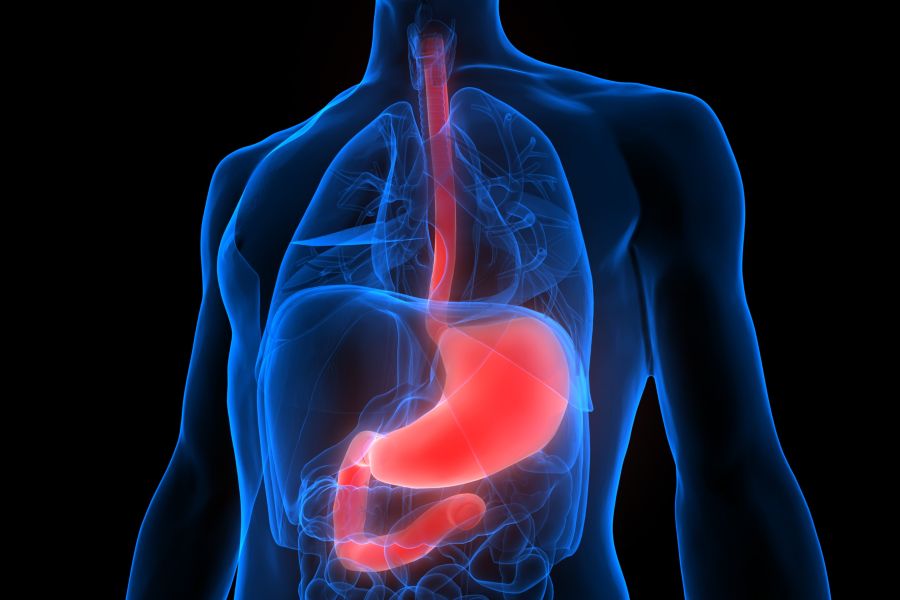
Esophageal cancer remains one of the most lethal malignancies worldwide. Even with multimodality therapy, the five-year survival rate remains below 25%. But advances in surgical approaches are helping lower the rate of complications, and those strategies are implemented at Northside Hospital Cancer Institute.
How robot-assisted surgery improves outcomes
Surgical resection — esophagectomy, or removing all or part of the esophagus — is the cornerstone of curative treatment. This typically following neoadjuvant therapy, such as chemotherapy or radiation therapy.
Over the years, the operative approach has evolved from morbid open transthoracic esophagectomy, a major surgery, to conventional minimally invasive esophagectomy (MIE), and now to robot-assisted minimally invasive esophagectomy (RAMIE). This shift is supported by prospective randomized evidence.
In the landmark ROBOT trial 112 patients were randomly selected for RAMIE versus open esophagectomy. The outcomes showed significantly lower overall surgical complications (59% vs. 80%; p=0.02), reduced pulmonary and cardiac events, less blood loss and lower pain scores. Patients also reported superior quality of life at discharge and six weeks post-operatively.
Additionally, R0 resection rates and lymph node yield remained equivalent at 40-month follow-up, meaning there was no evidence the cancer had resurged.
Large scale studies also support robot-assisted surgery’s advantage
National Cancer Database analyses have since found a modest survival advantage for RAMIE over both conventional MIE and open esophagectomy. This is attributed to more complete mediastinal lymphadenectomy — removal of lymph nodes from the chest — and lower perioperative morbidity, or surgical complications, which allows patients to complete follow-up treatments earlier.
Global analyses also back up the findings. The Upper GI International Robotic Association (UGIRA) study group published the world's first multicenter international RAMIE registry analysis in 2020, documenting techniques and outcomes across high-volume centers. The registry establishes the infrastructure for ongoing quality improvement research.
The most recent UGIRA analysis, encompassing 3,192 procedures across 28 centers, documented progressive improvement in textbook outcome rates — from 39% to 49% in one case and 49% to 61% in another case). Centers that were past their learning curve (more than 70 cases), measurably superior results were achieved on all metrics.
Surgical care strategy is also key to improving patient outcomes
Surgical technique alone does not determine outcomes—perioperative care pathway is equally essential.
A study published in 2022 analyzed Enhanced Recovery After Surgery (ERAS) protocol compliance in 100 consecutive esophagectomy patients at Virginia Mason Medical Center. Those patients achieved a seven-day median length of stay with 45% of patients meeting an accelerated recovery benchmark of no more than six days. That is well below historical norms of 10 to 14 days.
The study's key finding was that length of stay was not predicted by comorbidities, tumor stage, or neoadjuvant therapy, but by postoperative complications disrupting ERAS benchmark achievement. This showed that establishing complication reduction as the primary lever for recovery optimization.
Broader esophagectomy-specific evidence also reinforces this. A 2025 BMC Anesthesiology study linked ERAS adherence exceeding 80% with improved three-year overall survival, and a 2024 Annals of Surgical Oncology analysis confirmed ERAS superiority over conventional care in complications and patient-reported quality of life to six months post-esophagectomy.
Conclusion
Full patient benefit in operative treatment of esophageal cancer is unlocked not only by robotic surgery but through the concurrent implementation of rigorous structured recovery protocols.
This is supported by evidence that, taken together, positions RAMIE as the operative standard for esophageal cancer at experienced centers. And the method’s perioperative advantages over open surgery are established by randomized trial.
These care trajectories are supported by data and driven by multidisciplinary team efforts of nurses, coordinators, dietitians, advanced practitioners, gastroenterologists and oncologists — like the team-based approach at Northside Hospital Cancer Institute.
LEARN MORE ABOUT ESOPHAGEAL CANCER TREATMENT AT NORTHSIDE.

References
- van der Sluis PC, van der Horst S, May AM, et al. Robot-Assisted Minimally Invasive Thoracolaparoscopic Esophagectomy Versus Open Transthoracic Esophagectomy for Resectable Esophageal Cancer: A Randomized Controlled Trial. Ann Surg. 2019;269(4):621-630.
- Kingma BF, Grimminger PP, van der Sluis PC, et al; UGIRA Study Group. Worldwide Techniques and Outcomes in Robot-Assisted Minimally Invasive Esophagectomy (RAMIE): Results from the Multicenter International Registry. Ann Surg. 2020. doi: 10.1097/SLA.0000000000004550.
- Kooij CD, de Jongh C, Kingma BF, et al; UGIRA Study Group. The Current State of Robot-Assisted Minimally Invasive Esophagectomy (RAMIE): Outcomes from the UGIRA Esophageal Registry. Ann Surg Oncol. 2025;32(2):823-833.
- Milone M, Kooij CD, Manigrasso M, et al; UGIRA Study Group. Anastomotic leakage following robot-assisted minimally invasive esophagectomy (RAMIE): which anastomosis should be preferred? Surg Endosc. 2025;39(9):5604-5612.
- Puccetti F, Klevebro F, Kuppusamy M, Han S, Fagley RE, Low DE, Hubka M. Analysis of Compliance with Enhanced Recovery After Surgery (ERAS) Protocol for Esophagectomy. World J Surg. 2022;46(12):2839-2847.
- Puccetti F, Klevebro F, Kuppusamy M, Hubka M, Low DE. ERAS guidelines-driven upper gastrointestinal contrast study after esophagectomy. Surg Endosc. 2022;36(6):4108-4114.
- Chen SJ, Shen CH, Chuang CY, Chang YT. Impact of the ERAS protocol on 3-year survival following esophagectomy. BMC Anesthesiol. 2025;25:256.
- Huang Y, Xie Q, Wei X, et al. Enhanced Recovery Protocol Versus Conventional Care in Patients Undergoing Esophagectomy for Cancer. Ann Surg Oncol. 2024;31(9):5706-5716.